By Luke Mehdi
This question set can be horrible, especially if you have no experience of street markets. Even if you do live in a place where there are street markets, you may not visit them often or spend much time thinking about them.
Below, I have written about my experience of two very different street markets. As you read the descriptions, think about the following questions:
- What did I think of street markets before I visited these places?
- What was being sold at these markets?
- What did they smell like?
- What sounds were there?
- What about the colours in these markets?
- How do I feel thinking about my memories?
A tale of two street markets
I love street markets. In the UK, I had never really visited them, because I associated them with low-quality clothing and cheap plastic toys. However, visiting street markets abroad gave me a new appreciation for them. Now I enjoy visiting markets wherever I am in the world, whether in the UK, Europe, or somewhere more exotic altogether!
Wangfujing Night Market, Beijing
My first real experience of a street market was in Beijing, where I visited the famous Night Market at Wangfujing. The things on the stalls ranged from the mundane to the bizarre (at least to me!) Alongside things that I’m familiar with like toffee apples and chips (French fries in American English), there were scorpions, seahorses, starfish, silkworm larvae, and all kinds of fruit that I didn’t even know the names of in English. It was a shocking new cultural experience
Having recently arrived in China, the Night Market felt truly exotic. The smell was mouth-watering, as all the spices of the world were used to cook various types of meat in ways that I’d never encountered. Stallholders were shouting in Mandarin Chinese, a whole new language that I had rarely heard spoken. I couldn’t even start to read the Chinese characters, and often, the interesting and unusual English translations did little to help me identify what was being sold. The crowd was packed into the small alley, with a loud buzz of conversation amid the hustle and bustle. Everything was colourful, especially in the glow of the red lanterns so common in parts of Beijing.
I soon got used to the atmosphere, and spent many evenings wandering around the Night Market, until I felt more at home in the unusual surroundings. After a while, I started to feel amused by the expressions of amazement mingled with horrified fascination amongst tourists visiting for the first time. I imagined that my expression must have been the same the first time the sensory experience of the market overwhelmed me!
In a way, it’s a sad memory for me because I feel a sense of loss. I doubt I will ever feel so excited or stimulated by an entirely novel cultural experience again. For the rest of my life, a piece of my heart will always miss those first months in Beijing, and I will never forget my first time walking along the Night Market at Wangfujing.
Kadikoy Market, Istanbul
Another street market experience that I remember fondly was when I visited Kadikoy Market in Istanbul. It’s an open-air market which is spread across several streets. It’s full of all kinds of fresh produce, as well as soap shops, bakeries and cafes. Whereas the Night Market in Beijing is mainly a tourist attraction, Kadikoy Market is more practical and sells many everyday food essentials.
As you walk along the market, the smells change with the produce being sold. At one moment, the whole street smells strongly of fresh seafood, with fish of all shapes and sizes; the next, the aroma changes to one of scented soaps. Even if you were blindfolded, you would know what was being sold around you just by the smell.
In the section of the market selling fish, there were large tanks of prawns, scallops, crabs and lobsters. In front of the tanks, large trays of ice were filled with oysters, tuna and salmon, as well as many smaller species of fish. They were mostly silver, but almost all also had blue or green patterns on their skin. Above the shouts of the traders trying to attract customers, the Ezan, or Islamic call-to-prayer, rang out across the city from the dozens of mosques in Istanbul. Although I couldn’t understand the words, the melody was as beautiful as it was haunting.
A little further down the street, the fish market gave way to shops and stalls selling different soaps, all made with olive oil. The air was filled a mix of scents, from flowers like rose and lavender, to pungent smells of fruit and herbs. These soaps were colourful, with a range of reds, greens, oranges and yellows, depending on what had been used to give it its smell. In the soap shops, there were also some tourist souvenirs, but these were relatively few compared to the other produce on sale. The market at Kadikoy is a working market, catering more to the locals than visiting tourists.
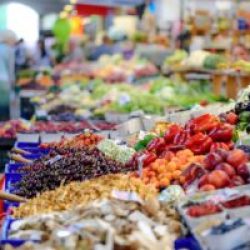
A little further along the street, there were also many other types of fresh produce. Again, this was accompanied by a kaleidoscope of colour. All manner of fruit, vegetables and enormous green and black olives covered every stall. The hot Mediterranean climate of Turkey had created the largest peppers, oranges and lemons that I have ever seen. The smell of freshly baked bread carried through the street from the dozens of small cafes and bakeries occupying the buildings. All the while, there was a low hum of sound as people bargained with traders or stopped to chat to someone they knew. Above this noise, there was the constant cry of seagulls which is so common in a major port city.
Comparing Wangfujing Night Market and Kadikoy market
Kadikoy was an amazing market. It was not strange to me, unlike Wangfujing Night Market. I knew what all of the things on sale were, and although there were still many colours and smells, there was nothing that was particularly new or unusual. However, the produce was not the only difference. The atmosphere was calmer and the sounds of the call-to-prayer and seagulls made it exotic in a very different way to the market in Beijing.
I miss Kadikoy Market and would love to return there in the future. However, the memory isn’t sad, because I know that I would feel the same way as the first time I went to Kadikoy Market. I don’t think I will ever again experience the same sense of novelty and wonder that I felt the first time I went to Wangfujing Night Market.






1 thought on “IELTS Speaking part 1 | Street markets”
Thank You teacher Luke, I had fun reading your article. Both were great experiences, I felt that I was with you, so much details.
Looking forward to read your other articles.